
Forestry mulching, palmetto removal, lot clearing, and site prep from the coastal ridge to Loxahatchee acreage — free itemized quotes.
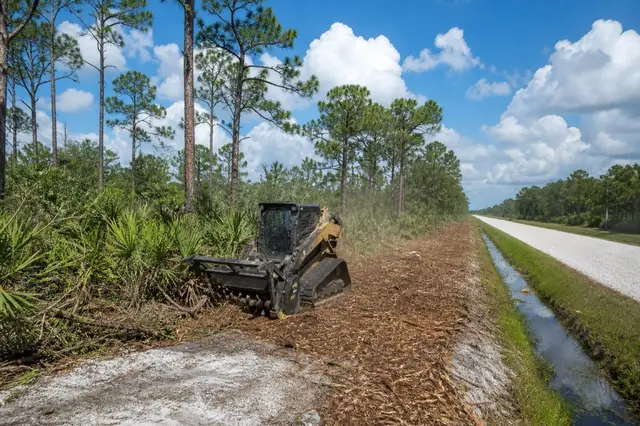
Since 1987 the county's Environmental Resources Management has regulated native vegetation removal. Commercial parcels and homesites of 2½ acres and up need their vegetation permit before clearing; the contractor folds it into the job.
PBC ULDC Art. 14.COpen burning of land-clearing debris takes Florida Forest Service sign-off plus setbacks that most residential parcels simply can't meet. Drum mulching turns the same vegetation into a chip layer that protects the sand instead.
FDACS Open-Burning RulesMelaleuca and Brazilian pepper crowd the Everglades fringe from Westlake to Wellington, and both sit on Florida's prohibited plant lists. County code backs their removal — this is one region where clearing actually helps the native woods.
PBC ULDC Art. 14.D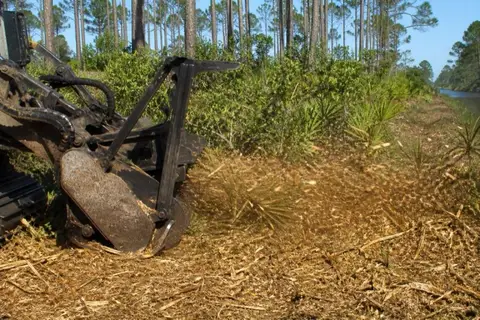
A drum head shreds palmetto, myrtle, and small trees where they stand, leaving chipped cover that holds Palm Beach County's loose sand in place.
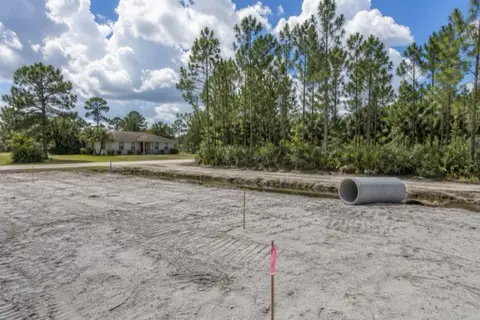
Wooded homesite to permit-ready pad: selective take-downs, grubbed footprint, and clean staging for the builder's first inspection.
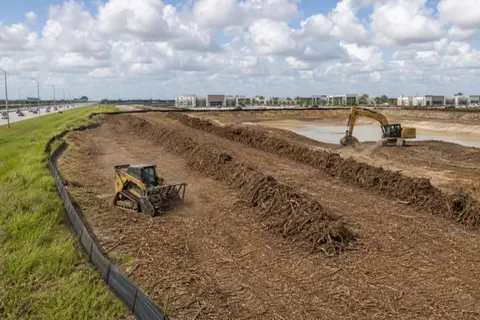
Multi-acre clearing for commercial builds — ERM permitting, staged erosion control, and production rates that hold a schedule.
| Light growth, per acre | $733–$2,333 |
| Dense tree cover, per acre | $3,395–$6,155 |
| Drum mulching, hourly | $150–$250 |
| First stump out | ≈$326 |
| Each stump after | $40–$83 |
| Brush knockdown, per acre | $20–$200 |
Wet corners, pepper walls, and shell-rock access roads all move a Palm Beach County job within those ranges. The only number that counts is the written one for your parcel — and that one's free.
Get My Written NumberYou and the contractor cover the parcel on foot — keeper oaks, wet spots, where the trailer parks, what "cleared" means to you.
Property corners, tortoise burrows with their 25-foot cushion, and every tree that stays get flagged before anything with tracks arrives.
Palmetto, myrtle, and invasives go through the drum head and come out as ground cover. Pads and drives get grubbed to the roots.
Fill placed where the parcel sits low, surface shaped to shed water toward the swale, and the finished job checked line-by-line against the quote.
Palm Beaches Land Clearing connects property owners across West Palm Beach and Palm Beach County's western communities with a local land clearing contractor for drum mulching, saw palmetto and underbrush removal, melaleuca and Brazilian pepper eradication, lot clearing, stump grinding, and building-pad preparation. Every job is scoped for this county's conditions: pale flatwoods sand over a shallow wet-season water table, roughly 63 inches of rain a year, canal-front access over culvert crossings, and gopher tortoise surveys with their 25-foot buffers walked before any drum head spins.
Tell us about the ground — a Palm Beach County land clearing contractor replies with itemized numbers.
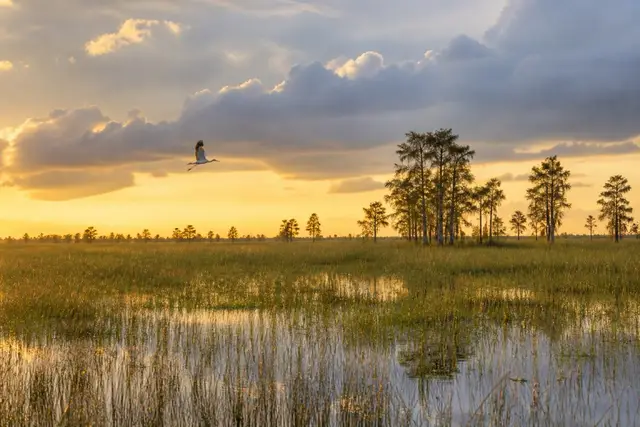

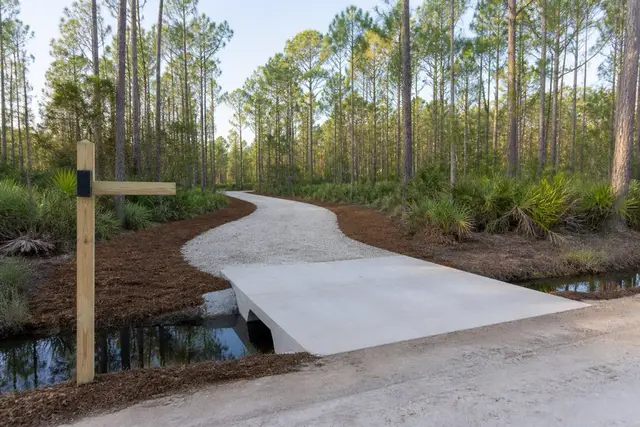
Coastal ridge to horse country, drawn not to scale
National price guides for 2026 put light clearing between roughly $733 and $2,333 an acre, with dense tree cover climbing past $6,000. Around here the real variable is the ground itself: a dry Acreage lot mulches fast, while a parcel with a wet cypress corner or a wall of Brazilian pepper takes more machine hours. That spread is exactly why this site only deals in written, itemized quotes for your specific parcel — never a number guessed over the phone.
Often. In unincorporated Palm Beach County, Environmental Resources Management requires a vegetation removal permit for commercial sites and for single-family parcels of two and a half acres or more; smaller homesites generally clear under their building permit. Incorporated towns — Wellington, Jupiter, Palm Beach Gardens and the rest — run their own rules on top. The contractor your request reaches treats that paperwork as the first line item of the job.
A tracked machine with a drum head grinds palmetto, brush, and small trees where they stand, leaving chipped ground cover instead of debris piles. On South Florida's loose gray sand that cover matters: it holds the surface through summer downpours. It also means nothing gets burned — open burning of cleared vegetation needs Florida Forest Service approval and comes with distance rules that rule most parcels out anyway.
They change the sequence, not the outcome. Florida protects the tortoise and its burrow, and machines have to keep 25 feet away from any burrow that might be occupied — closer work needs an FWC permit first. A proper job starts with someone walking the parcel and flagging burrows before an engine starts. Overgrown lots in The Acreage and Jupiter Farms turn them up all the time, so the walk-through is not a formality.
Removing them is arguably the most local service on this site. Both species are on Florida's prohibited plant lists, Palm Beach County's code pushes their removal when land gets developed, and the western communities sit right against some of the heaviest infestations in the state. Clearing them out — roots included, so they don't resprout — is standard work for the contractor this site connects you with.
It makes the introduction. This is an independent marketing site for one trade in one county: your call or form goes to a local land clearing contractor who walks the property, writes an itemized price, and does the work if you hire them. The quote costs nothing, and every agreement afterward is directly between you and the contractor.